Navigating Life’s Transitions

READING: To a Daughter Leaving Home, Linda Pastan              

When I taught you

at eight to ride

a bicycle, loping along

beside you

as you wobbled away

on two round wheels,

my own mouth rounding

in surprise when you pulled

ahead down the curved

path of the park,

I kept waiting

for the thud

of your crash as I

sprinted to catch up,

while you grew smaller, more breakable

with distance,

pumping, pumping

for your life, screaming

with laughter,

the hair flapping

behind you like a

handkerchief waving

goodby.


            The poem by Linda Pastan brought back memories of my learning to ride a bicycle.  It was my father who taught me.  By the time I was nine, I could ride my bike to my best friend’s house so I must have been around eight or younger.  Before that, I had a red tricycle on which I was fearless speeding in circles around the columns of our concrete basement.  There was a time in-between when I got the light blue two-wheeler with training wheels securely attached.  As I recall, it was relatively easy switching from the tricycle to the bike with training wheels.  The biggest challenge was learning to brake by reversing directions of the pedals instead of just throwing my feet on the ground while the wheels were in motion.  A bicycle of course was much further off the ground then my red tricycle.  A sign that I was growing up!


            However, once those training wheels came off, I longed for my good old tricycle!  I had a hard time finding my balance.  I was afraid of falling.  I was afraid that if I ever got going, I would not be able to stop.


            I grew up in West Newton, Massachusetts on Waltham Street, a road with a constant buzz of traffic.  Directly across from our house was the Swedish Home, a nursing home set back from the road with a long circular driveway.  When my father could see how frustrated and discouraged I was we crossed the street with the light blue bike between us to practice while my mother prepared dinner.


            I don’t remember how many times we went to practice but it became an afternoon ritual.  My father would hold the handlebars while I got the rhythm of pedaling.  Later, he held the back of the bike and simply let go when my pedaling seemed more confident. 


            After a while, we had an audience.  The residents of the Swedish Home started gathering on the front porch to see this father and daughter routine.  When my father pointed them out to me, I felt shy at first.  My father explained that they too first learned to ride a bicycle and they were simply cheering me on.  After a while, a group was always out there to greet us as we walked the bike across the street and up the driveway at the usual time. We exchanged friendly smiles and waves.


            My father was a wonderful coach.  When I exclaimed “I can’t do this!” he encouraged me.  His steady reassuring presence motivated me to keep trying and never give up.  When I fell over and scraped my hands, he’d whistle a few bars of a song that continues to echo in my head to this day, “Pick yourself up, brush yourself off, try all over again!”  One day, I was able to ride without my father’s steady guiding hand.  I found my balance pedaling on my own and even engaged the brakes—the start of my journey toward independence.  Now I could ride my bike to my best friend’s house on my own.


            The determination to persist even when at first I do not succeed is a lesson that has helped me face many challenges and transitions through out my life.  My father offered the same steadfast reassuring support as I learned to drive, auditioned for plays, went to college, applied for jobs, felt called to the ministry, purchased my first home, and committed myself in marriage.  The transitions were always mine to face but the fact that my father believed in me gave me the confidence to move forward in unfamiliar territory.


            On this Father’s Day, I am keenly aware that my father is facing his own unfamiliar territory.  His mind is increasingly clouded by dementia and his body has become frail.  My mother is offering him steady reassuring support by caring for him at home with the aid of home healthcare workers.  He is afraid of the transition from life to death although I have tried to assure him that he will be at peace.  At this point, there is no disease nor prognosis so we do not know how long this slow goodbye will continue.  Even though I am not able to visit with him as often as I would like, my heart is with him as I know his heart is with me, across geographical distance and ultimately when the veil of death passes between us.  As I face this life transition, my faith assures me that the bonds of love remain unbroken and timeless.


            Today we honor the transition of our youth toward adulthood.  At the end of the service, this community will create a bridge symbolic of this life passage.  In truth, each one of us no matter our age is navigating life’s transitions.  Some of these changes call on us to learn new skills or face new challenges.  There are new chapters which we consciously choose for ourselves that help us move toward our personal goals.  There are other transitions like the loss of a loved one or an obstacle unforeseen but no less real on our life’s journey.  There are times when the love and support of family or church community is close at hand, cheering us on, providing comfort, and offering inspiration.  There are other times when our new chapter takes us far away from all that is familiar to face unknown territory alone.


            I want all the youth to know that even though we might not see one another as often, this community is here for you.  I am only an email away anytime you have a challenge or a success you would like to share.


For all people who navigate life’s transitions, we offer inspiration from our Unitarian ancestors, first Ralph Waldo Emerson who was present at the dedication of this historic church, “Nothing is secure but life, transition, the energizing spirit.”  And then the following words from Henry David Thoreau who had Emerson as his friend and mentor, “Go confidently in the direction of your dreams.  Live the life you have imagined.”  Foremost when you fall literally or spiritually hum a few bars of the simple tune, “Pick yourself up, brush yourself off, try all over again.”  
Mindful Eating Habits Bind Us to All Creation

Growing up, my mother planted a small vegetable garden in our backyard.  I enjoyed working alongside her in the dirt.  I watched with fascination as the plants grew.  Even more, I loved picking fresh produce and carrying it indoors in a basket for my family to eat. 


One day, my mother sent me to harvest our first carrots.  I ran outdoors firmly grasping the green leaves and pulled the vegetable from the earth.  Only to discover that carrots do not come in bunches!  From the packages of carrots in our fridge, somehow I had assumed that under each carrot top was a whole bunch not just a single orange root.


For most of us, food comes from the supermarket.  We have become accustomed to choosing our meals from the shelves of the store often packaged in a way that has little resemblance to any living thing.  With our busy lives, many of us choose frozen dinners and prepared meals over the raw ingredients.


Each food item in the United States typically travels 1,500 miles before it reaches our plates.  This includes all the produce that we can enjoy year round and processed foods.   


Many of us treat food like fuel, eating to fill up our tanks in order to keep active.  A whole industry of fast food has built up around our desire for convenience allowing us to eat on the run.  Many Americans eat in the car en route to another destination.


Eating becomes a religious experience when we are mindful of the source of our food and our interdependence with other living beings.  Truly it is a miracle that seed, soil, sun, and water contribute to what becomes food.  The food that we eat is essential to our lives nourishing and sustaining us.


This fall, we held a Harvest Dinner where church members were invited to bring dishes made of local ingredients.  If we were unable to find a local product, the challenge was to at least to identify the source.  This was an eye-opening exercise!  The Farmers Market provided many locally-grown and raised staples.  In cooking, we had to consider where in the world our spices came from.


This lesson about eating locally or at least being mindful about the source of food has stuck with me.  Choosing natural ingredients over processed ones are healthy choices both for me and our world.  Despite the temptation of junk food, real food is more deeply satisfying.


My family has decided to plant a small vegetable garden this summer.  Our yard is small but there is a patch out back where the sun shines brightly for at least six hours a day.  I am looking forward to working the soil and planting.


I have also decided to subscribe to Community Supported Agriculture (CSA).  Simmons Farm in Middletown helps build a direct relationship between people, food, and the farm.  Through a subscription, we will receive a share of certified organic vegetables every week during the months of June through October.  This will give us the opportunity to experience the workings of a farm more closely and to eat in rhythm with the season.  If you are interested in learning more about Simmons Farm drop by 1942 West Main Road or call 848-9910.


Of course, not everyone has the resources to plant a garden or to choose organic foods.  Many children around the world and close to home will go to bed hungry tonight.  Saturday morning, April 26th is the annual Aquidneck Island CROP WALK Against Hunger.  This is an opportunity to join an interfaith movement in our community by walking three or ten miles.  The funds raised will go to hunger relief globally and locally. For more information, check out http://www.cropwalk.org.


The word “religion” comes from the Latin root “religare” meaning “to bind back.”  Mindful eating is religious because it binds us back to our wholeness with all of creation.  Instead of simply refueling, let us make healthier choices that awaken our sense of reverence and gratitude for living.  This type of nourishment will feed our sense of joy and generosity!

What does Confucius say?


The Master said “The rule of virtue can be compared to the Pole Star which commands the homage of the multitude of stars without leaving its place.” (2:1)


The Master is none other than Confucius.  The passage is from The Analects, a collection of Confucius’ sayings.  Originally compiled by his students in 497 B.C., the philosophy of Confucius continues to inform contemporary East Asian society influencing both political culture and spiritual life.  Confucius’ sayings offer guidance for living a moral life that remains relevant for us today.


Book 2, Chapter 1 touches upon several essential ideas within Confucian thought.  This saying is attributed to Confucius himself which suggests its importance.  It is concerned with the moral nature of a ruler.  If a ruler has a virtuous character, then the subjects will naturally follow.  Proper government is by example or moral persuasion not through force or coercion.  The use of celestial imagery gives a sense of the cosmic order after which human beings should pattern themselves.  Confucius presents a model of Harmony in which Heaven, Earth, and Humanity work in an orderly fashion.  He asserts that by following moral principles and customs the ideal society is attainable.


Confucius was not satisfied with the moral character of government.  The missing element was “virtue”.  Much of The Analects is devoted to describing the nature of “virtue”.  The main principles include: benevolence, righteousness, wisdom, courage, trustworthiness, and filial piety.  If these qualities are present in rulers, the welfare of the people is guaranteed.


Unfortunately, the moral character of American government is questionable.  There is growing concern that the current Administration has deceived the American people.  The United States is viewed with suspicion and even hatred by much of the world.  Although American leaders often talk about the values of freedom, peace, and justice, some of our actions cast our integrity as a nation into doubt. 


The American people are looking for a leader who fits Confucius’ description like the Pole Star, a beacon of hope.  This is one of the most wide-open Presidential elections in recent history.  During the debates, candidates often become derailed from the issues by sniping at each other.  Our leaders need to move beyond divisiveness to realize our greater unity and to address substantive matters.      


The Master said, “When you meet someone better than yourself, turn your thoughts to becoming his equal.  When you meet someone not as good as you are, look within and examine your own self.”  (4:17)


The moral imperative is not to root out the short-comings of other people but to continually strive to better one’s self.   According to Confucius, individuals should strive to improve their characters by emulating those people who are “better” or “of superior quality”.  When encountering a person who is “not as good”, the instruction is to “look within and examine your own self”.  Our central concern should always be self-cultivation. 


Our actions are important.  Our words have weight.   Our thoughts also matter as they govern our behavior and attitudes.  As a spiritual practice, all people (even political candidates!) should strive to cultivate virtue by paying attention to our judgments about others and shifting focus back to oneself. 


Try this simple practice in the week ahead.  When you think someone is better than you, do not put yourself down instead think how you can emulate his or her positive qualities.  When you think other people are lesser than you, instead of dismissing them or dwelling on their faults, consider why that judgment or frustration arose within you and how you will move forward with virtue like benevolence, courage, and trustworthiness. 


In order to achieve greater harmony than we have known, each one of us needs to be engaged with the upcoming election, participate in public service, and foremost set our own hearts in order.              For as Confucius says,

If there is righteousness in the heart, there will be beauty in the character.

If there is beauty in the character, there will be harmony in the home.

If there is harmony in the home, there will be order in the nation.

If there is order in the nation, there will be peace in the world.

Theodore Parker: A Life of Reform

Theodore Parker: A Life of Reform


What can we do to make things better?  Foremost, we need to believe that it is possible to make things better, to reform society for the common good.  When my faith wavers, I often turn to my spiritual ancestors for inspiration.  Unitarian minister, Theodore Parker (1810-1860) lived the charge of his friend Ralph Waldo Emerson, “What is man born for, but to be a reformer?”


“What can we do to make things better?” was Theodore Parker’s constant refrain.  He asked this question again and again to the crowds that assembled to hear him while at the same time searching his own mind and heart.


Parker and fellow Transcendentalists believed that all people are endowed with God-given abilities to bring forth truth, beauty, and justice.  This means that not only the politicians have the answers to the problems of our times.  In fact, the politicians may be more clouded from the truth.  Parker would assert that every person has knowledge that can benefit the common good.  It is part of our very make-up.  We are born with the ability to discern right from wrong, as long as we listen to the still small voice within.


Theodore Parker began his ministry as a scholar and a pastor.  As he listened to the “voice of God in the soul” or “conscience”, he became increasingly a reformer.  He was a close friend of George Ripley and so often visited the utopian community of Brook Farm, interested in the intellectual exchange and new forms of living being tried there.  In the end, Parker concluded that although Brook Farm might have been a success for individuals, really the members were escaping the ills of society.  The experimental community did not advance society, solve problems or reform institutions.


Parker spoke out about issues of labor, property, war, education, women’s rights, and temperance.  He was a tireless abolitionist speaking in Faneuil Hall, serving as a stop on the Underground Railroad, and even marrying escaped slaves.  Theodore Parker had the wisdom to say in response to Biblical passages often cited in support of slavery, that if the Bible supported slavery, the Bible was wrong.  He pressed people to see a Higher Law than the superstition of religious dogma.  Parker also pressed people to see a Higher Law than economics and property.


What can we do to make things better?  We too must listen to “the voice of God in the soul” or “conscience” welling up within us to distinguish right from wrong.  We must believe in a Higher Law than individualism and materialism.


We are intelligent people.  We can understand the interests of corporations.  We know why jobs have been outsourced.  We know why manufacturing is now parceled out so that the companies can deliver the cheapest products to Americans, the top-consumers of the world.  However, the interests of these ever-larger corporations operating in a global market should not rise above the worth of the human family.  The cost of jobs lost to the mechanization of labor is too high.  The cost of food and toys being manufactured by workers with few rights and questionable practices is too high.  Private ownership of water is against Higher Laws. 


What can we do to make things better?  Foremost, we must believe in democracy and the principles of freedom.  In a speech at the New England Anti-Slavery Convention in Boston, Parker said, “There is what I call the American idea. . . . This idea demands, as the proximate organization thereof, a democracy,–that is, a government of all the people, by all the people, for all the people; of course, a government of the principles of eternal justice, the unchanging law of God; for shortness’ sake I will call it the idea of Freedom.”  This speech actually inspired President Abraham Lincoln.  Now more than ever, we need to preserve “a government of all the people, by all the people, for all the people”.  After all, what are we born for, but to be reformers?


Rev. Dr. Carl Scovel dedicates Channing portrait

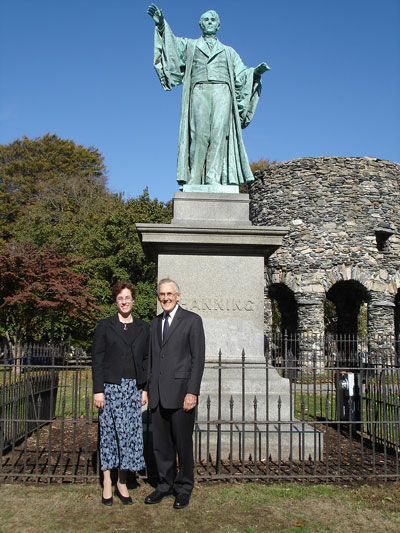
Rev. Dr. Carl Scovel and the Rev. Amy Freedman in front of the statue of William Ellery Channing facing Newport’s Channing Memorial Church.

Rev. Dr. Carl Scovel and the Rev. Amy Freedman in front of the statue of William Ellery Channing facing Newport’s Channing Memorial Church.

For many years, a ghostly black and white photograph of William Ellery Channing (1780-1842) looked down from over the fireplace in the Parish Hall of Channing Memorial Church. The image of the Unitarian minister reminded the congregation of our unique connection to the Newport native who defined American Unitarianism in the early nineteenth century. However, whenever I looked into his face, I could not help but think he looked sad and weary.

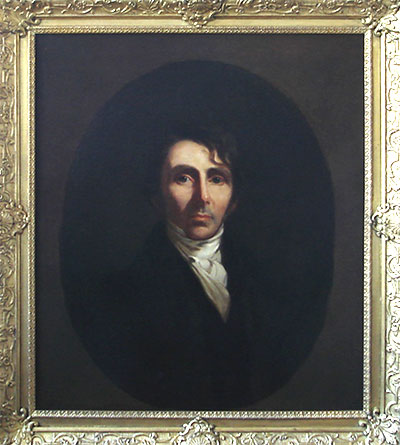
Last year, I was approached by the Rev. Dr. Carl Scovel who inquired if our church had a Channing portrait by Spiriodione Gambardella. When I told him about our photograph, Carl explained that he had a copy of the painting that he would like to entrust to the care of a congregation bearing Channing’s name.

I took the opportunity pay a visit to Rev. Scovel and see the painting first hand. How refreshing to see William Ellery Channing in color! I was delighted to discover Channing had blue eyes. The portrait has a vibrancy that our photo did not convey.

In fact, this was the one likeness with which Channing himself was satisfied. In a letter to his son, dated 1835, Channing complained of existing paintings of him by Gilbert Stuart, Chester Harding and Charles C. Ingham, as well as a pencil sketch by Edward G. Malbone and a bust by Persico: “I am certainly not vain of my exterior. My countenance would not make me many friends, I fear. What has troubled me in my different portraits is, not that they have not given me a more intellectual expression, but that so little benevolence has beamed from my features. I have learned with the Apostle, to prefer charity to all knowledge; and if I am to be handed down to posterity, I should be pleased to speak from the stone or canvass, or rather to breathe from it, good-will to mankind.”

Channing wrote to his son in 1838, “Mr. Gambardella has succeeded in his work. My friends are entirely satisfied with the picture. It is not only a good likeness, but a meritorious work of art. After so many unsuccessful attempts, this poor face is faithfully transferred to canvas, and, on the whole, is better worth looking at than I supposed.”

Two copies were made of the original by Gambardella, which is owned by Harvard Divinity School. One copy was made in 1867 by Darius Cobb (1834-1903) and Cyrius Cobb (1834-1919) twin brothers who often worked together is owned by Arlington Street Church in Boston, the congregation William Ellery Channing served for his entire ministry.

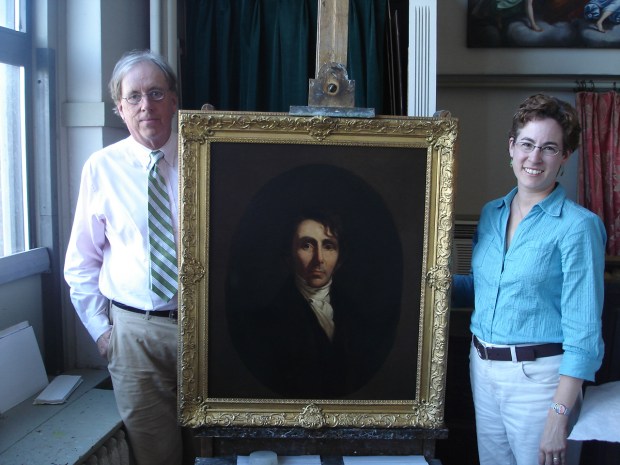
The artist of the second copy was a contemporary of the Cobb brothers but remains unknown. However the painting holds a special place in the history of liberal religion as it hung in the study of the Rev. Dr. Dana McLean Greeley who was the first President of the Unitarian Universalist Association. Dana Greeley was also Carl Scovel’s father-in-law. Since Carl inherited the painting, he felt that it should be hung in a church dedicated to Channing. The painting was cleaned and the gilt frame restored by Peter Williams’ Museum Services in Boston who also happens to be a Unitarian Universalist.

Peter Williams, Channing and Rev. Amy Freedman

It is truly an honor to receive a painting that holds such an important place in the history of our liberal religious movement. As a part of the service on Sunday, November 4th, the Rev. Dr. Carl Scovel will preach and the portrait of William Ellery Channing will be dedicated and hung in our Sanctuary. All are welcome to this historic and meaningful event!